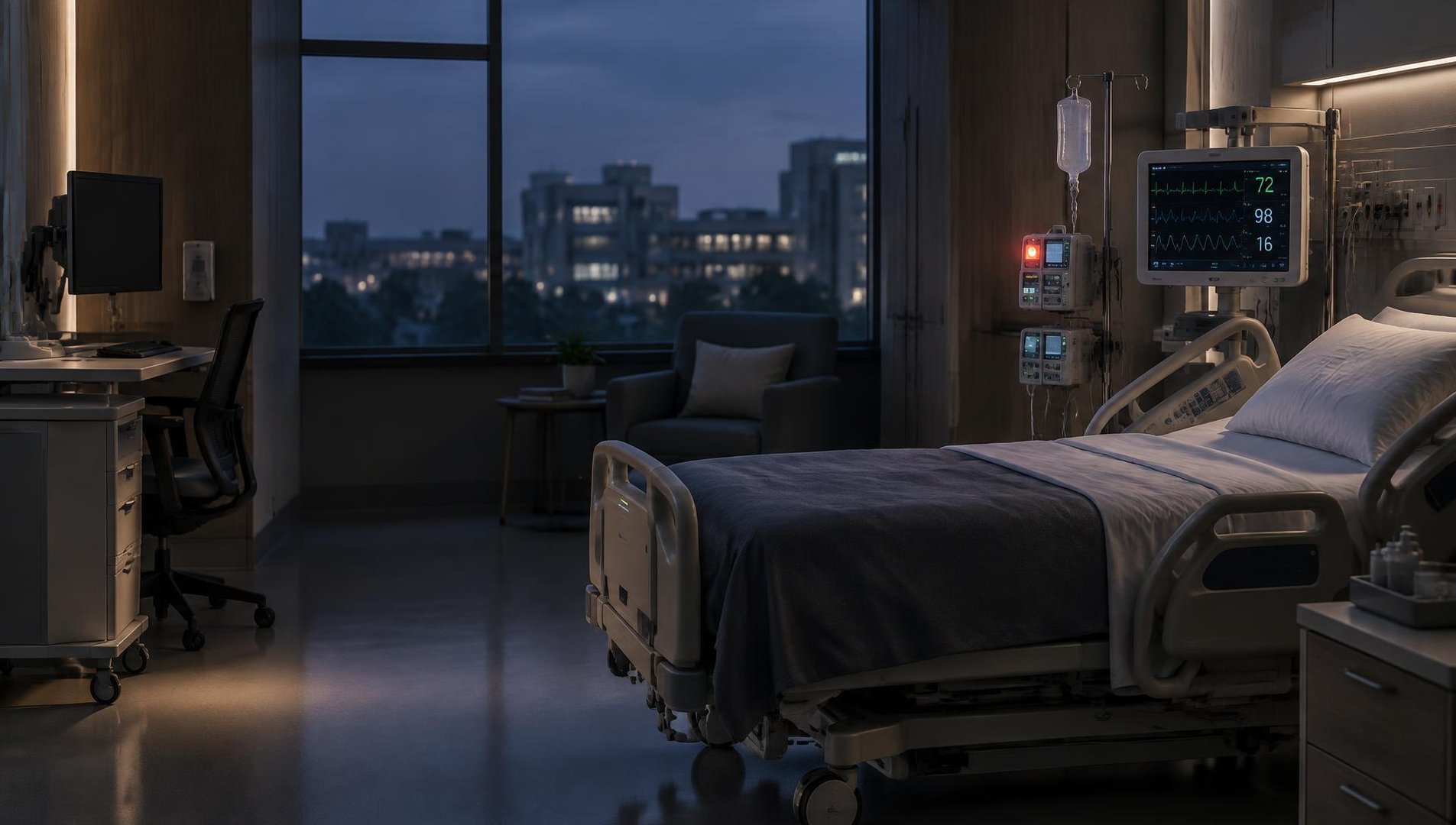
Research suggests nurses may be exposed to as many as 5,000 alarms during a single shift, with studies indicating that between 85% and 99% of alarms require no clinical intervention.1 Alarm fatigue has become such a significant concern that The Joint Commission, the independent organization that accredits and certifies thousands of U.S. hospitals and health care organizations, identified medical device alarm safety as a national patient safety priority after alarm-related events were associated with serious patient harm and death.2 That expectation remains in force: under the Joint Commission’s National Performance Goals, which replaced the National Patient Safety Goals in January 2026, hospitals must continue to improve the safety of clinical alarm systems.3
The impact extends far beyond missed alarms.
For clinicians, constant auditory stimulation contributes to cognitive overload, distraction, emotional exhaustion, and burnout.4 A 2026 meta-analysis of 23 studies identified false or non-actionable alarms and high alarm burden as leading drivers of alarm fatigue among intensive care unit (ICU) nurses, which was in turn associated with burnout, perceived stress, and a greater tendency toward medical error.5 In a 2025 multicenter study, ICU nurses rated monitor and ventilator alarms as the most disruptive noise source, and noise exposure was significantly associated with fatigue, headaches, anxiety, and reduced concentration.6
These pressures further compound an existing workforce challenge.7 National projections indicate that demand for registered nurses will continue to rise, with an 8% national shortage projected for 2028 and shortages projected to persist through 2038. By then, nonmetro areas face an 11% shortage, and states such as California (22%), Georgia (20%), and North Carolina (20%) face shortages of 20% or more.8 In that context, reducing avoidable environmental stress is not simply a workforce well-being initiative; it is part of a longer-term strategy to protect scarce clinical capacity, support retention, and sustain care delivery.
For patients, noise can interfere with sleep and impact recovery,4 and can negatively influence their overall perception of care. In fact, “Quietness of Hospital Environment” is the lowest-scoring of the eight publicly reported Hospital Consumer Assessment of Healthcare Providers and Systems (HCAHPS) measures nationwide, with a median top-box score of 60 compared with 87 for the highest-scoring measure.9 The updated HCAHPS survey also introduces a new “Restfulness of Hospital Environment” measure, signaling growing attention to patients’ ability to rest.10 Noise is not an isolated issue but a widespread healthcare experience challenge.
The consequences are measurable. Studies suggest a 10% decrease in patient satisfaction can reduce admissions by approximately 5%,11 making the care environment a strategic consideration.
“The question is no longer whether hospital noise is a problem. The question is why it persists.
The root cause
A healthcare system builtaround alerts
For decades, medical technology innovation has focused on identifying clinical events and generating alerts when predefined thresholds are crossed at the point of care.
This approach has helped to improve patient monitoring and contributed to numerous advances in patient safety. However, it has also created an increasingly reactive model of care.
Many monitoring technologies, such as threshold-based alarms and intermittent vital sign checks, are designed to respond to physiological deviations after they become evident. The result is an ecosystem where hospitals continuously generate alarms in response to events that have already occurred or are already progressing.1213
As more devices, applications, and systems are introduced into patient care environments, the number of alerts naturally increases. Yet more alarms do not necessarily equate to better outcomes.
Healthcare organizations increasingly face a paradox: despite generating more patient data than ever before, much of that information remains fragmented, difficult to access, or underutilized—studies suggest as much as 80% of healthcare data goes unused.14
The result is an environment where care teams spend significant effort reacting to notifications rather than proactively managing patient risk.
Alarm fatigue, therefore, is not simply a technology problem.
It is a symptom of a broader care delivery challenge.
A different question
Using analytics to reducethe burden
Progressive health systems are increasingly shifting their focus away from simply managing alarms and toward understanding why alarms occur in the first place.
Rather than accepting alarm burden as an unavoidable consequence of patient monitoring, many organizations are implementing alarm governance programs, reviewing alarm policies, standardizing monitoring practices, and analyzing alarm trends. Accreditation expectations reinforce this work: the 2026 Joint Commission standard asks hospitals to set alarm priorities using input from medical staff, patient risk, alarm fatigue concerns, and incident history.3
The goal is not to eliminate alarms. The goal is to ensure that alarms are meaningful. This requires insight.
Hospitals need visibility into which alarms occur most frequently, where they originate, how often they result in intervention, and what changes can safely reduce nuisance alerts without compromising patient safety. This is where analytics-driven alarm management is becoming increasingly important.
Many hospitals have historically lacked the visibility needed to quantify alarm burden and model the effects of proposed alarm-setting changes. Through on-demand alarm analytics and modeling capabilities, healthcare organizations can review alarm patterns across devices, units, and facilities, helping clinical leaders identify non-actionable alarms and evaluate strategies to reduce unnecessary notifications before changes are introduced into patient care environments.15
Spacelabs Healthcare alarm analytics
A hospital used Spacelabs Healthcare alarm analytics to review its alarm data and identify opportunities to safely optimize alarm parameters. One change alone—an adjustment to a single arrhythmia alarm setting (R-on-T PVC)—made the difference.15
When resources are stretched, the ability to assess likely impact before implementation becomes increasingly important.
“Meaningful alarm reduction is not about turning alarms off. It is about using data to determine which alarms matter most.
Beyond alarm reduction
What if hospitals could reducealarms by preventing deteriorationbefore crisis conditions occur?
This is where the conversation shifts to proactive care, eliminating unnecessary alarms at the source.
Traditional early warning scoring systems such as Modified Early Warning Score (MEWS) and National Early Warning Score (NEWS) represented important steps forward in patient surveillance. However, many conventional scoring methodologies rely on intermittent vital sign observations and a relatively limited set of clinical inputs.16
Research has highlighted persistent concerns surrounding early warning surveillance tools, including inconsistent adoption, limited clinician confidence, and modest impact on outcomes.16 Vital signs can also be an incomplete or late signal. In a study of more than 109,000 ICU patients with infection and new organ failure, one in eight did not meet the standard criteria for systemic inflammation, which are based largely on vital signs, potentially delaying recognition of critical illness.17
In other words, some surveillance systems may identify deterioration only after significant physiological decline has already developed.18 The cost of late recognition is substantial. A 2025 study of more than 519,000 adult inpatients across 15 U.S. hospitals found that patients with unplanned ICU transfers 48 hours or more after admission had 25.1% mortality, compared with 1.9% for patients who were not transferred; after adjustment, these late transfers carried an 18-fold increase in mortality risk and a two-fold increase in length of stay.19 By that stage, alarms, rapid response activations, ICU transfers, and care escalations can become unavoidable.
Predictive awareness
Earlier recognition, fewer crises
A growing number of healthcare organizations are adopting innovative predictive surveillance tools that identify subtle signs of deterioration risk.
This approach requires a shift from reactive monitoring to predictive clinical surveillance. By continuously analyzing multiple clinical variables, including vital signs, laboratory data, nursing assessments, and cardiac rhythm information, advanced surveillance technologies can provide a more comprehensive view of patient risk and deterioration trajectories, enabling care teams to identify subtle changes in condition earlier and intervene before crisis occurs.18
Rather than waiting for crisis-driven alerts, clinicians gain earlier visibility into patients who may require intervention.18
The goal is not simply to improve alarm management.
The goal is to create fewer situations that require alarms in the first place.
Inpatient mortality
relative reductionICU transfers
reductionCare escalations
reductionAverage length of stay
reductionEarlier recognition
increase in rapid response activationsOutcomes reported by a recent U.S. multi-hospital study following adoption of Spacelabs Healthcare’s Predictive Early Warning Surveillance analytics. 18
Independent research points in the same direction. In a 2025 cluster-randomized trial of more than 60,000 hospital encounters across two health systems, an early warning system driven by nursing documentation was associated with a 35.6% lower risk of in-hospital mortality and an 11.2% shorter length of stay.20 That trial also saw more unanticipated ICU transfers, consistent with earlier escalation of at-risk patients. A 2025 meta-analysis of prospectively validated AI-based deterioration models similarly found lower in-hospital mortality (odds ratio 0.69) and modestly shorter hospital stays.21
These findings suggest that when deterioration is identified sooner, hospitals can intervene before patients reach crisis thresholds that trigger intensive alarms, emergency responses, and avoidable escalations.
The outcome is not only quieter units, but improved performance.
Connected workflows
When communication becomes part of the noise
Not all noise in acute care is audible or comes from alarms.
Some can be created by uncertainty: uncertainty about whether a message has been received, whether a monitoring task has been completed, whether the patient is still in the same location, or whether the record reflects the latest decision. Each unanswered question prompts another call, another check, or another handoff. Individually, these interactions may appear routine. At scale, they can fragment attention and consume clinical capacity that is already in short supply.
The opportunity is not to communicate less, but to make essential communication effective.
That distinction matters: reducing avoidable exchanges and duplicate manual work can create a calmer working environment without weakening collaboration or oversight. Within the Spacelabs Healthcare Workflow Management Suite, closed-loop digital communication confirms that messages are received and acted on, so information and required actions move between care team members more efficiently.
Oklahoma City-based INTEGRIS Southwest Medical Center adopted the Spacelabs Healthcare Workflow Management Suite and redesigned its telemetry processes around a common, digitally supported closed-loop communication workflow. Oklahoma is among the states facing a double-digit projected nursing shortage (13% by 2038),8 making efficient use of clinical time especially important.
Through workflow and patient throughput optimization, INTEGRIS achieved a quieter, more controlled environment—evidence that improved workflow and care team coordination delivers financial advantages.22
This outcome suggests that the environment of care is shaped not only by alarm settings, but by the workflow coordination of the wider management system around them.
The journey forward
Quiet, focused care
The future of hospital noise reduction will not be achieved by simply silencing alarms. Instead, it will require healthcare organizations to confront a more fundamental question: Are we managing the alarms and distractions, or are we addressing the conditions that create them?
The aim is not silence for its own sake. It is a care environment in which clinically meaningful information is easier to distinguish, communication is more targeted, and teams have greater opportunity to act before deterioration becomes a crisis.1822 In that sense, quieter care is not simply an environmental outcome; it is an expression of a more proactive, focused, and sustainable model of care.
Adopting the right evidence-based, integrated data management solution has demonstrated that data-driven alarm governance can:18
- Reduce nuisance alerts
- Improve workflow efficiency
- Help clinicians identify deterioration earlier and intervene before crisis occurs
Together, these approaches offer a path toward quieter care environments, more sustainable clinical workflows, and improved clinical and operational outcomes for both patients and care teams.1822