

Ambulatory Blood Pressure Monitoring
See the Whole Blood Pressure Picture
Capture blood pressure beyond the clinic with 24-hour ambulatory monitoring. Spacelabs Healthcare ABPM solutions provide daytime, nighttime, and real-world blood pressure insights to support more informed hypertension assessment and management.
Since 1980
Decades of ABPM experience supporting clinicians and researchers.
24-Hour Insights
Capture daytime, nighttime, and real-world blood pressure patterns.
Clinically Validated
Technology supported by extensive clinical validation and experience.
Clinical & Research Insights
Turn repeated measurements into meaningful trends and patterns.
Blood pressure doesn't stand still. Why should assessment?
Key takeaway: Instead of relying on isolated measurements, clinicians can evaluate patterns and changes across a patient's real-world day. 24 hours. Day and night. A more complete blood pressure picture.
Why Ambulatory Blood Pressure Monitoring Matters
24-Hour Blood Pressure
Review blood pressure across the complete monitoring period rather than at a single point in time.
Daytime Blood Pressure
Understand how blood pressure behaves while patients perform their normal daily activities.
Nighttime Blood Pressure
Evaluate blood pressure during sleep—information that cannot be obtained from conventional clinic measurements.
Blood Pressure Variability
Identify changes and patterns that may not be visible from individual readings.
Circadian Patterns
Evaluate the relationship between daytime and nighttime blood pressure, including normal and abnormal dipping patterns.
Key takeaway: Together, these measurements provide a broader foundation for hypertension assessment, risk evaluation, and treatment decisions.
Beyond the Office Blood Pressure Reading
What clinic measurements may not reveal
White-Coat Hypertension
Some patients experience elevated blood pressure in a clinical environment while their blood pressure outside the clinic remains within a normal range.
This phenomenon, commonly known as white-coat hypertension, can make an office measurement appear higher than the patient's typical blood pressure.
By measuring blood pressure during everyday activities and sleep, ABPM helps clinicians compare office findings with the patient's real-world blood pressure profile.
Masked Hypertension
The opposite can also occur. A patient's blood pressure may appear normal or controlled during a clinic visit while remaining elevated outside the clinical environment.
Known as masked hypertension, this pattern can be difficult to recognize when assessment relies primarily on office measurements.
ABPM provides measurements throughout the patient's normal day and night, helping reveal blood pressure elevations that may not be apparent during an appointment.
A Limited Snapshot
Blood pressure changes continuously. One or two measurements cannot fully represent the fluctuations that occur during activity, stress, medication cycles, rest, and sleep.
ABPM provides repeated measurements over approximately 24 hours, helping clinicians move from individual readings toward a more complete assessment of blood pressure behavior.
Nighttime Blood Pressure: Insights You Can't See in the Clinic
Normal Dipping
Blood pressure decreases during sleep as expected.
Non-Dipping
Nighttime blood pressure does not decrease to the expected degree.
Reverse Dipping
Blood pressure increases rather than decreases during sleep.
Isolated Nocturnal Hypertension
Blood pressure is elevated during sleep even when daytime or clinic measurements may appear normal.
Key takeaway: These patterns cannot be adequately assessed through conventional office blood pressure measurements alone. Nighttime and 24-hour blood pressure measurements provide important information for cardiovascular risk assessment, adding another dimension to hypertension evaluation.
ABPM and Cardiovascular Risk Assessment
Better information supports better-informed decisions.
How Ambulatory Blood Pressure Monitoring Works
Prepare the Patient
A compact ambulatory blood pressure monitor is connected to an appropriately sized upper-arm cuff.
The monitor is programmed in the clinical setting, and the patient receives instructions for the monitoring period.
Begin 24-Hour Monitoring
The patient leaves the clinical environment wearing the monitor and continues normal daily activities.
The device automatically inflates the cuff and records blood pressure at predetermined intervals—commonly more frequently during daytime hours and at longer intervals during sleep.
Capture Day and Night Measurements
Throughout the monitoring period, the system collects blood pressure measurements during normal real-world conditions.
Patients may also document sleep and wake times, medication intake, physical activity, symptoms, and significant events. This contextual information can help clinicians interpret changes in the blood pressure record.
Download and Review the Results
After the monitoring period, the patient returns the monitor and the recorded information is downloaded for analysis.
Clinicians can review mean 24-hour, daytime, and nighttime blood pressure, blood pressure variability, individual measurements, circadian patterns, and nocturnal dipping status.
Key takeaway: The result is a structured view of blood pressure behavior that can support diagnosis, treatment decisions, and follow-up.
Supporting Hypertension Diagnosis
Key takeaway: By capturing the patient's blood pressure during real-world activities and sleep, ABPM provides additional evidence to support diagnostic confidence.
Evaluate Treatment Across the Full Day and Night
Key takeaway: Repeat ABPM can also provide an objective method for comparing blood pressure profiles over time and supporting longitudinal hypertension management.
Designed Around the Patient's Real Life
Key takeaway: Supporting patient comfort and compliance can contribute to a successful monitoring session and the collection of useful 24-hour blood pressure information.
Proven Ambulatory Blood Pressure Monitoring Technology
Confidence built on decades of clinical use
AAMI/ANSI/ISO standards
European Society of Hypertension protocols
British Hypertension Society protocols
Key takeaway: This combination of validation, clinical experience, and research use supports confidence in ambulatory blood pressure measurements across a variety of healthcare environments.
From Measurement to Meaningful Clinical Insight
Key takeaway: Structured reporting also provides a clinical reference that can support communication, treatment planning, and longitudinal comparison.
ABPM Across the Continuum of Care
Primary Care
ABPM can help confirm suspected hypertension, evaluate discrepancies between office and out-of-office measurements, and provide additional information for treatment decisions.
Cardiology
Detailed 24-hour blood pressure information can contribute to cardiovascular risk assessment and hypertension management.
Nephrology
Because hypertension and kidney health are closely connected, ambulatory blood pressure patterns can provide valuable information for patients requiring more comprehensive blood pressure assessment.
Hypertension Clinics
Specialized hypertension programs can use ABPM for diagnosis, blood pressure phenotyping, treatment evaluation, and longitudinal monitoring.
Pharmacy-Based Care
Where regulations and clinical practice allow, pharmacies can incorporate ABPM into hypertension services, expanding access to out-of-office blood pressure assessment and supporting collaboration with other healthcare professionals.
Clinical Research
ABPM provides standardized, repeated blood pressure measurements and has been extensively used in hypertension research and clinical trials.
Explore Spacelabs ABPM Solutions
Ambulatory blood pressure monitoring designed for confident care
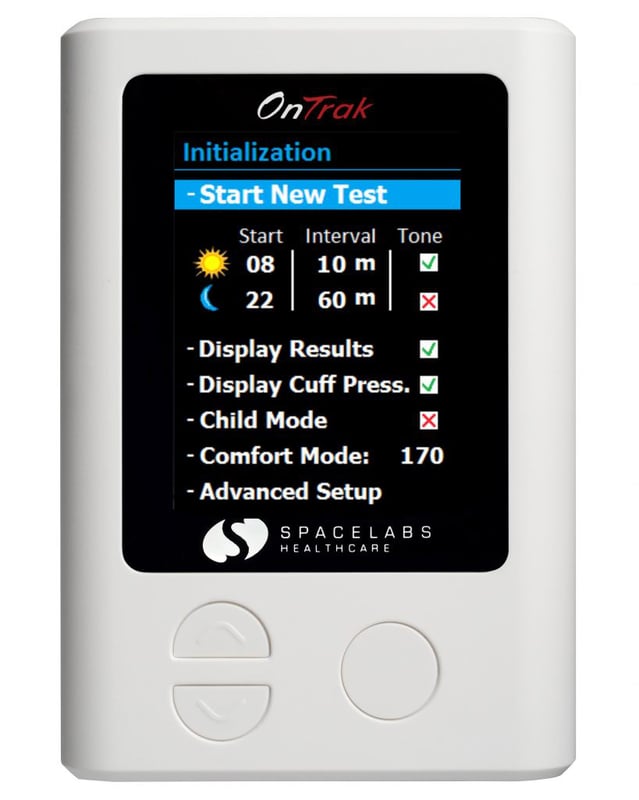
OnTrak
A modern ambulatory blood pressure monitoring solution designed to support reliable 24-hour blood pressure assessment while considering both clinical workflow and the patient experience.
Why Choose Spacelabs Healthcare for ABPM?
Experience you can measure. Insights you can use.
Clinically Validated Technology
ABPM solutions supported by extensive validation and clinical experience.
24-Hour Blood Pressure Insights
Capture daytime, nighttime, and real-world blood pressure behavior.
Patient-Focused Design
Compact, wearable solutions designed to support patient comfort during everyday activities and sleep.
Powerful Analysis and Reporting
Transform multiple measurements into structured clinical information.
Workflow Support
Solutions designed to help healthcare organizations efficiently implement and manage ambulatory blood pressure monitoring.
Clinical and Technical Expertise
Support that extends beyond installation to help organizations successfully integrate ABPM into their care environment.
Frequently Asked Questions About ABPM
See the Whole Blood Pressure Picture
Better information. Better-informed decisions. Better care.